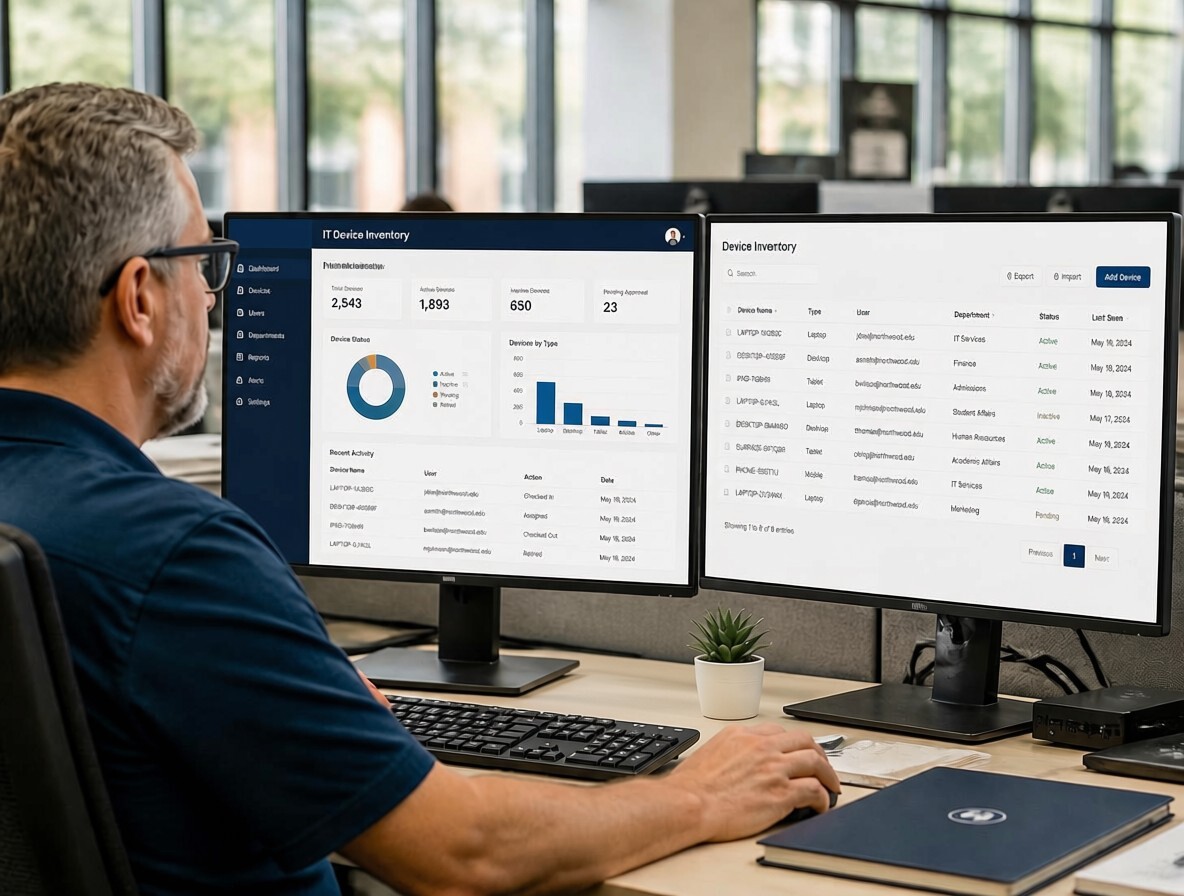
We take care of all your campus device purchasing, deployment, repair and certified data destruction. Faculty laptops. Shared lab stations. Departmental workstations. All in one program.
Device sprawl, disposal backlogs, and IT teams stretched across faculty, staff, and shared spaces — all at once.
Most mid-size universities have 30 or more departments making their own device decisions. That creates a mixed fleet of dozens of models. Each has different warranties, repair paths, and end dates — and no single IT team can track it all efficiently.
Based on research into higher education IT governance
Faculty devices typically have a 3-4 year life span. When multiple departments get there simultaneously, IT teams confront a buying, setup and disposal bottleneck that in-house people aren’t scaled for.
Standard measure for higher-ed IT refresh cycle
Every retired equipment that contained student records, financial aid information, or research data requires a documented destruction report. When scaled up to hundreds of faculty computers and lab machines per cycle, that documentation becomes a legal gap. It needs to be regulated, not wished for.
FERPA 34 CFR Part 99 · GLBA Safeguards Rule
We manage faculty laptops, shared lab stations, and departmental workstations through every stage of their life — from buying through certified disposal.
Replace scattered department buying with one vendor, bulk pricing, and a consistent device setup standard across every school and office.
Devices arrive pre-set and enrolled. Faculty and staff can start using them right away. Your help desk doesn't have to get involved.
Break-fix repair with loaner coverage keeps faculty and staff working. Your help desk stops being a device repair queue.
Certified data wipe, documented chain of custody, responsible recycling — and any remaining device value credited back to your budget.
Your legal team, your board, and your financial assistance office will ask you about data handling. We have designed our service so the answers are ready.
We sign a Data Privacy Agreement (DPA) before handling any device that may contain student data. FERPA (the Family Educational Rights and Privacy Act) mandates that student records be protected at all stages of a device's life, including disposal. Our method is designed around that demand, not on top of it.
The GLBA Safeguards Rule, often known as the Gramm-Leach-Bliley Act, mandates colleges and universities to protect financial information. This contains information on the devices used by financial aid and student accounts staff. Our NIST 800-88 wipe and recorded destruction process complies with the Safeguards Rule's disposal requirements.
Every retired device is wiped according to NIST SP 800-88 guidelines. You will receive a Certificate of Destruction for each device, which will be requested by your legal, compliance, and audit teams. Physical devices are recycled in accordance with the R2/RIOS standard. This is the responsible electronics disposal certification for institutional-scale recycling.
Higher education purchasing does not follow a single path. Many institutions can move faster using cooperative contract vehicles than with complete RFPs. We understand how each framework works, and we'll assist your procurement office in finding the most efficient complying way.
The cooperative purchasing mechanisms listed below are active structures that institutions commonly use to acquire technology services. Each was competitively bid to comply with public procurement regulations. Tell us where your institution stands, and we'll tell you which road is the fastest for you.
Don't see your institution's contract?
Contact us — we'll confirm your purchasing path within one business day.
Drag to the size of your managed fleet. The figures are updated in real-time using benchmarks published for IT labor
What number of devices does your campus IT team manage?
Estimates are based on published IT benchmarks: 8% annual device damage rate (LocknCharge K–12 Device Research, 2024); ~1 hour of IT handling time per incident (LocknCharge, “The True Cost,” Feb. 2026); $100/hr midpoint of $75–$150/hr IT support personnel rate range (LocknCharge, Feb. 2026). This solely includes hands on handling, not time for IT oversight, sourcing or disposal. Your real numbers will be different.
Get your exact numbers — free assessmentWe will evaluate your present device mix across departments. We'll estimate your repair and replacement costs over the following three years. You'll see how much your retired devices are worth against how much a managed program costs per device, per year.
Only for higher education IT teams.
No obligation. No sales pitch on initial contact.